
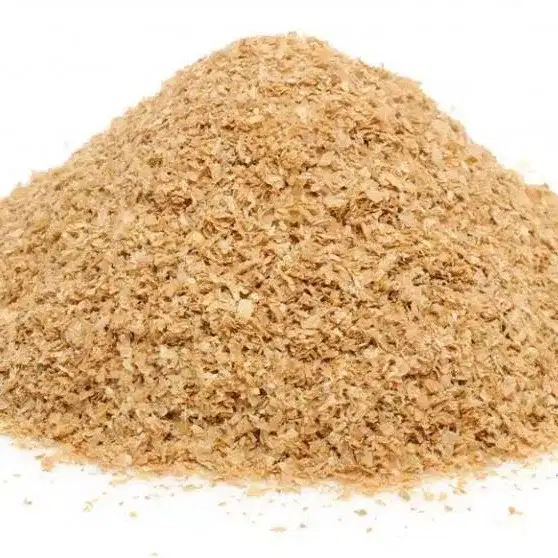
Wheat Bran
- Physical State
- Solid
- Appearance / Color
- Light brown to golden flakes
- Odor
- Characteristic grain
- Moisture Content (%)
- <14%
- Synonyms & Trade Names
- Wheat middlings; Coarse wheat bran; Bran
- Total Plate Count (TPC)
- <2,000,000 CFU/g
Categories
Technical Document
Brief Overview
Wheat (Triticum aestivum L.) milling yields a high protein by-product that is suitable for broad classes of livestock and animal. Wheat bran can be served to cattle, poultry, sheep, pigs, and horses. Wheat bran is bulky, making it useful to lighten the feed mixture. Wheat bran can also be fused into the form of mashes.
Because of the high fiber level and its laxative effect, wheat bran is better not to be fed to young livestock. Below is nutrition value of the product
Parameter Value Dry Matter 87 - 88% as fed Crude Protein 14 - 17% DM Crude Fiber 6 - 10% DM Crude Fat 4% DM NDF 45 - 46% DM ADF 13.5% DM Lignin 4% DM Ash 5 - 6% DM
Starch 22 - 23% DM Sugars 7 - 8% DM Gross Energy 18.9 MJ/kg
Manufacturing Process
Wheat bran is produced as a side product of milling of wheat into white flour. Wheat bran was sifted, washed, and dried at 180°C–200°C for 30–40 min and then ground. Wheat is usually milled by roller milling, which delivers multiple product streams that the miller can combine into flour or bran fractions. Thus, the composition of wheat bran from different mills varies significantly.