For years, procurement teams focused primarily on supplier risk, pricing volatility and inventory management.
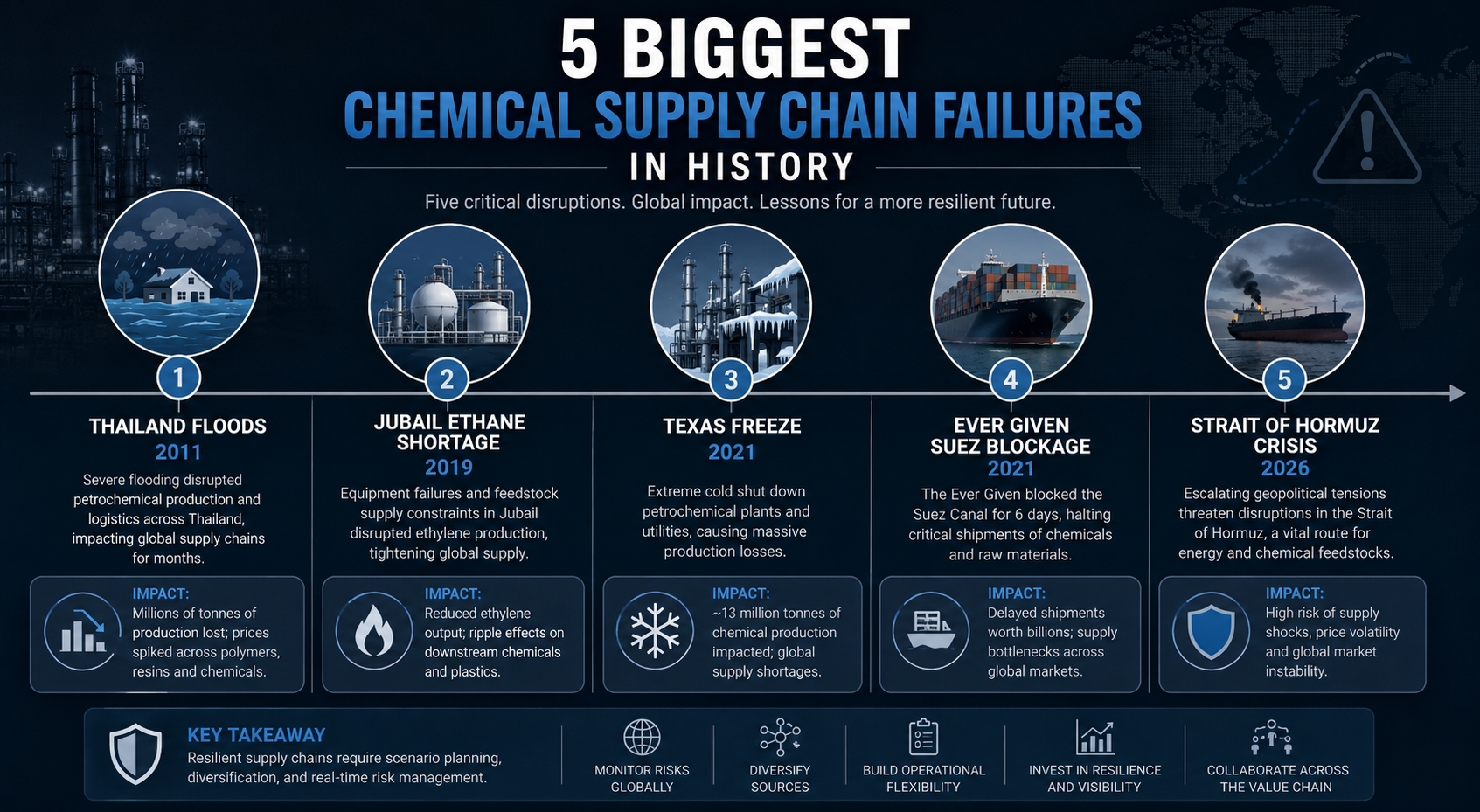
The 2026 Hormuz crisis introduced a fourth factor that can no longer be ignored:
Shipping route risk.
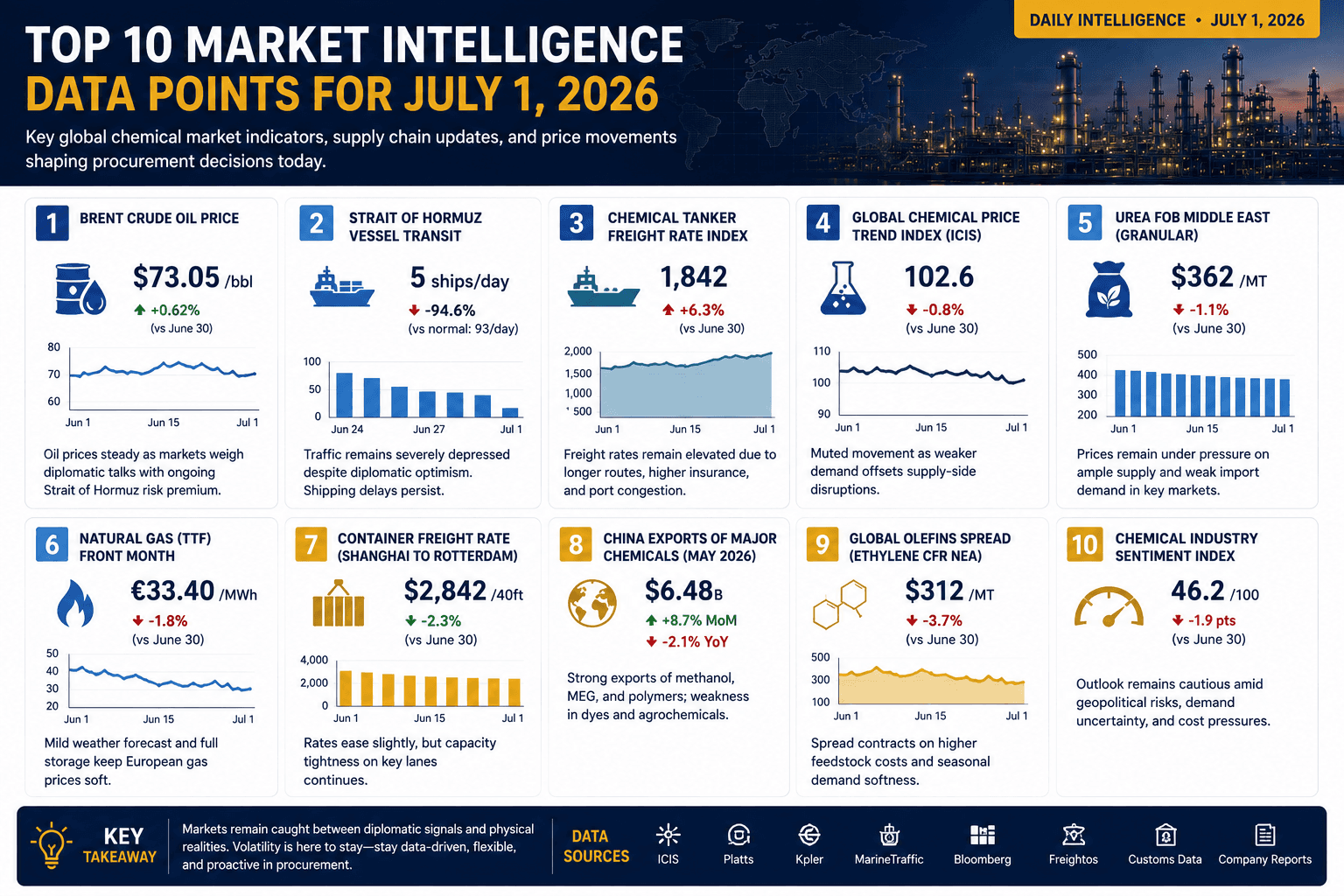
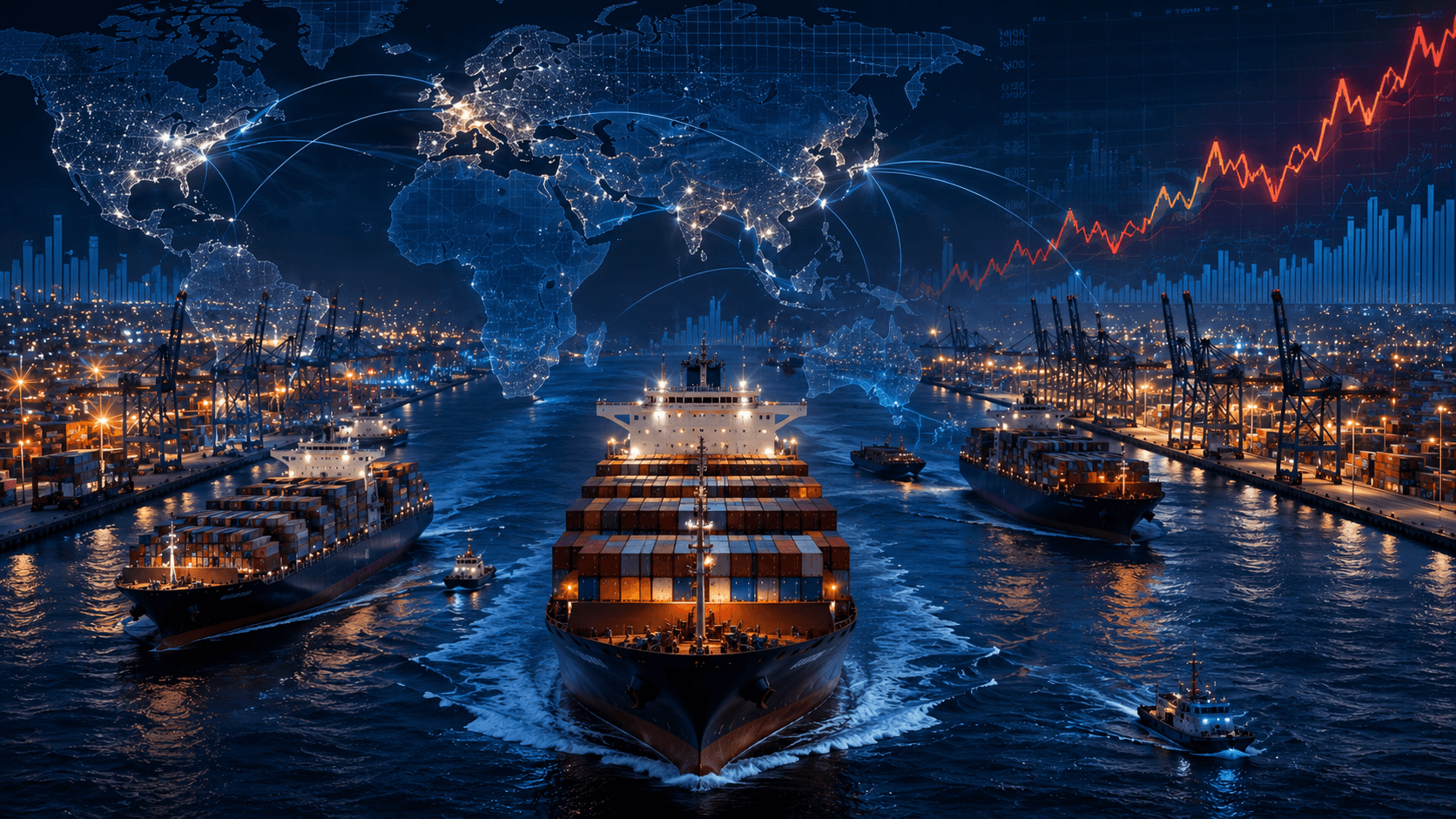
When a single maritime corridor experiences disruption, the consequences can spread through global chemical supply chains within days. Freight rates surge, lead times expand, inventories tighten and production schedules become vulnerable.
The lesson from 2026 is clear: supply chain resilience requires understanding not only who supplies your chemicals but also how those chemicals move around the world.
Why Chokepoint Risk Matters
Global chemical trade depends heavily on a small number of maritime corridors.
Several routes handle disproportionate shares of:
Petrochemicals.
Fertilizers.
Energy products.
Industrial chemicals.
Specialty materials.
When one corridor experiences disruption, alternatives are often:
More expensive.
Slower.
Capacity constrained.
This creates cascading effects throughout chemical value chains.
The Hormuz crisis demonstrated that shipping geography can influence procurement costs as much as feedstock pricing.
The Four Critical Chemical Trade Chokepoints
The global chemical industry depends on four particularly important maritime corridors:
Strait of Hormuz
Handles major flows of:
Crude oil.
LPG.
Methanol.
Urea.
Polyethylene.
Petrochemical feedstocks.
Suez Canal
Critical for:
Asia-Europe trade.
Containerized chemicals.
Specialty chemical shipments.
Polymer exports.
Malacca Strait
One of the world's busiest shipping corridors linking:
China.
Southeast Asia.
India.
Europe.
Bab el-Mandeb
Connects the Red Sea to global shipping routes and supports traffic moving toward the Suez Canal.
Each corridor presents different risk characteristics.
Chokepoint Exposure by Chemical Category
Not all chemicals face equal transportation risk.
The following matrix provides a practical framework for evaluating exposure.
Very High Exposure
Methanol
Primary Risk:
Hormuz.
Why:
Heavy Middle East production concentration.
Limited alternative export routes.
Urea
Primary Risk:
Hormuz.
Why:
Significant Gulf export volumes.
Seasonal demand sensitivity.
LPG
Primary Risk:
Hormuz.
Why:
Major Gulf export dependence.
High Exposure
Polyethylene and Polypropylene
Primary Risks:
Hormuz.
Suez.
Why:
Large Middle East export base.
Extensive Asia-Europe trade.
Aromatics
Primary Risks:
Hormuz.
Malacca.
Why:
Regional production concentration.
Interconnected Asian supply chains.
Moderate Exposure
Organic Acids
Primary Risks:
Suez.
Malacca.
Why:
Multiple production origins.
Containerized trade flexibility.
Solvents
Primary Risks:
Suez.
Hormuz.
Why:
Diverse production footprint.
Significant international trade.
Lower Exposure
Water Treatment Chemicals
Primary Risks:
Regional logistics.
Why:
Multiple domestic production sources.
Lower dependence on long-haul trade routes.
Commodity Inorganic Chemicals
Primary Risks:
Regional transportation.
Why:
Widely distributed manufacturing base.
Which Chokepoint Is the Most Dangerous?
The answer depends on product category.
Hormuz
Greatest impact on:
Energy-linked chemicals.
Petrochemicals.
Fertilizers.
Suez
Greatest impact on:
Containerized chemical trade.
Asia-Europe commerce.
Specialty chemicals.
Malacca
Greatest impact on:
Asian manufacturing supply chains.
Electronics chemicals.
Industrial intermediates.
Bab el-Mandeb
Greatest impact on:
Europe-Asia routing.
Red Sea logistics.
Suez-linked trade.
For many products, multiple chokepoints create overlapping risks.
The Hidden Risk: Concentrated Production Plus Concentrated Logistics
The most vulnerable supply chains share two characteristics:
Production Concentration
Supply originates from a small number of producers or regions.
Logistics Concentration
Trade depends on a single maritime corridor.
When both conditions exist simultaneously, disruption risk increases dramatically.
Methanol is a textbook example.
Large production volumes originate from the Gulf while exports depend heavily on Hormuz.
The result is extreme chokepoint exposure.
How Procurement Teams Can Reduce Exposure
The goal is not eliminating risk entirely.
The goal is reducing dependence on any single failure point.
Diversify Origins
Avoid sourcing all supply from one region.
Examples:
Combine Middle East and Asian suppliers.
Balance Chinese and Indian sourcing.
Develop secondary suppliers.
Use Multiple Logistics Corridors
Evaluate whether products can move through alternative routes.
Increase Strategic Inventory
For highly exposed products, safety stock provides valuable protection.
Expand Contract Coverage
Long-term contracts often provide priority allocation during disruptions.
Conduct Route Mapping
Many companies know their suppliers but not the routes used to deliver products.
Route visibility is increasingly important.
A Practical Supply Chain Resilience Checklist
Procurement teams should regularly evaluate:
Supplier Risk
How many approved suppliers exist?
Are suppliers concentrated geographically?
Route Risk
Which chokepoints are used?
Are alternative routes available?
Inventory Risk
How many days of coverage exist?
Is safety stock adequate?
Contract Risk
Do contracts include allocation protections?
Are force majeure provisions understood?
Logistics Risk
Are alternative carriers available?
Can shipments be rerouted?
Organizations that can answer these questions quickly are generally better prepared for disruptions.
What the Hormuz Crisis Changed Permanently
The most important outcome of 2026 may not be higher freight rates.
It may be a fundamental shift in procurement thinking.
Historically, many companies optimized for:
Lowest cost.
Lean inventories.
Single-source efficiency.
The Hormuz disruption highlighted the value of:
Resilience.
Flexibility.
Redundancy.
Visibility.
These priorities are likely to remain important long after the crisis subsides.
The Bottom Line
The 2026 Hormuz crisis transformed shipping route analysis from a logistics exercise into a strategic procurement discipline. Chemical buyers can no longer evaluate suppliers solely on price, quality and capacity. Understanding how products move through global chokepoints is now equally important.
Methanol, urea, polyolefins and other globally traded chemicals remain highly exposed to maritime disruptions, while products with diversified production bases generally face lower risk. By mapping chokepoint exposure, diversifying supply sources and strengthening logistics resilience, procurement teams can reduce vulnerability to future disruptions.
The companies that emerge strongest from 2026 will not necessarily be those that bought at the lowest price. They will be the ones that built supply chains capable of surviving the next disruption.