The global chemical industry is entering a period where supply security matters as much as pricing. The geopolitical risk chemical markets 2026 landscape is defined by concentrated trade routes, regional production dominance and rising policy intervention.
For procurement teams, traders and industrial buyers, geopolitical exposure is no longer theoretical. It directly affects availability, shipping routes, insurance costs and contract stability. This article maps the most exposed chemical markets and explains why risk concentration is increasing.
Why Geopolitics Now Defines Chemical Supply Chains
Chemical supply chains are uniquely exposed to geopolitical risk because they depend heavily on concentrated feedstock regions and maritime trade routes.
Unlike many manufactured goods, chemicals are often produced in large centralized facilities and shipped globally in bulk volumes. This creates structural vulnerability to disruptions.
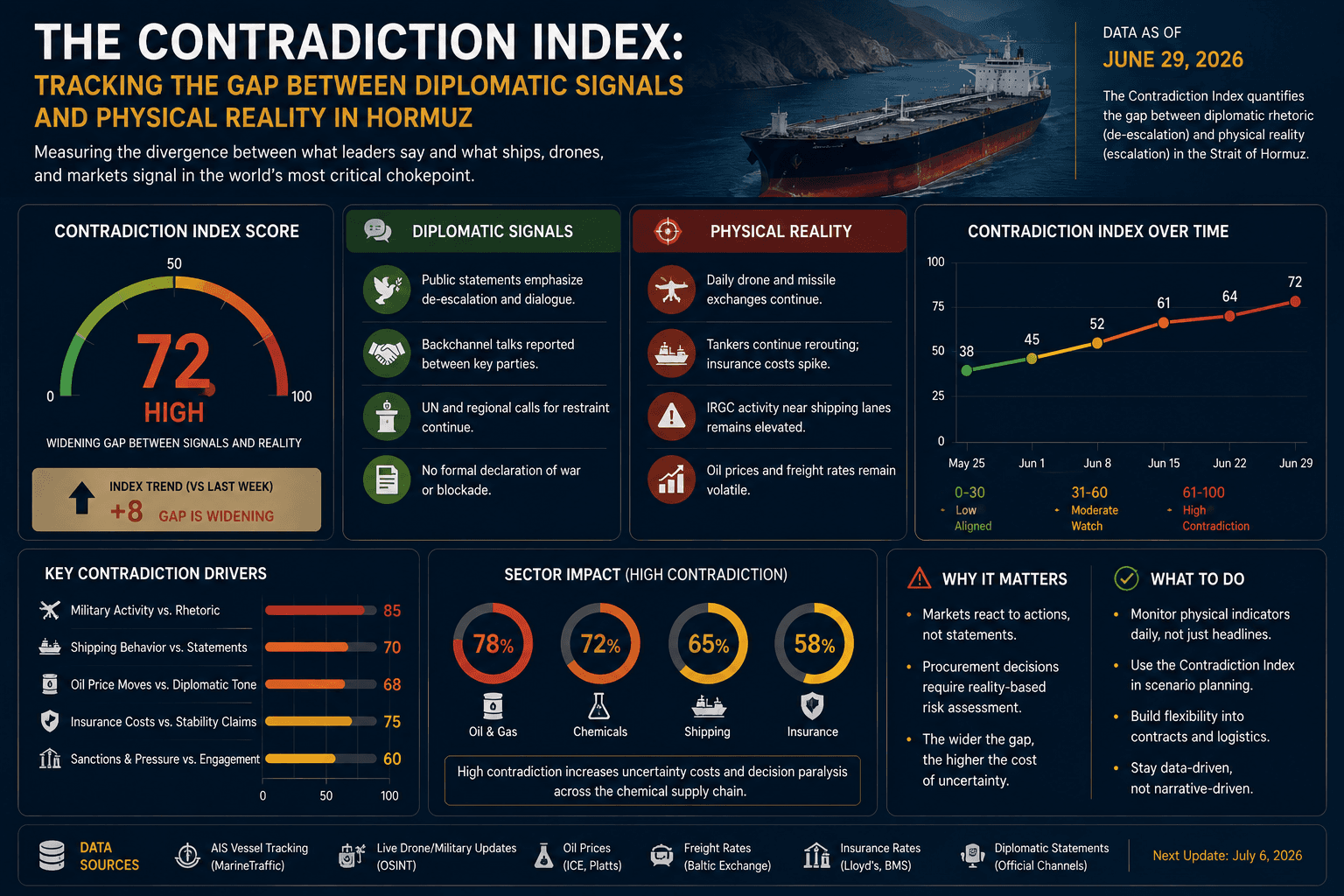
The 2026 Strait of Hormuz crisis has highlighted this exposure more clearly than any previous event.
A significant share of global chemical exports flows through this narrow maritime corridor, making it a critical chokepoint for energy and chemical logistics.
At the same time, trade policy interventions from major economies are adding a second layer of risk.
Tariffs, export controls and anti-dumping investigations are now directly influencing chemical trade flows.
Methanol and the Strait of Hormuz Exposure
Methanol is one of the most geopolitically sensitive chemicals in global trade.
Approximately 33 percent of global seaborne methanol trade passes through the Strait of Hormuz.
This creates significant exposure to shipping disruptions, insurance volatility and regional conflict risk.
Methanol is widely used in formaldehyde production, plastics manufacturing and fuel blending applications.
Any disruption in Middle Eastern exports can quickly impact pricing across Asia and Europe.
Because methanol supply chains rely heavily on large-scale export terminals, even short-term disruptions can create global price shocks.
Buyers increasingly treat methanol sourcing as a strategic risk category rather than a simple commodity purchase decision.
Urea, Ammonia and Fertilizer Supply Concentration Risk
Urea and ammonia markets are heavily concentrated in the Middle East.
Nearly 49 percent of global supply is linked to this region.
This concentration creates high exposure to geopolitical disruptions and maritime transport risks.
These chemicals are essential for agriculture and food production systems worldwide.
Any disruption in supply can rapidly translate into downstream food security concerns.
Fertilizer markets are particularly sensitive to shipping interruptions because of seasonal demand cycles.
Procurement teams in agriculture-related industries must therefore manage both timing and regional risk exposure carefully.
Polyethylene and Petrochemical Export Vulnerability
Polyethylene represents one of the largest volume petrochemical exports from the Middle East.
Approximately 84 percent of Middle East polyethylene output moves through the Strait of Hormuz.
This makes it one of the most exposed polymer supply chains globally.
Polyethylene is widely used in packaging, construction materials and consumer goods.
Disruptions in supply routes can quickly affect manufacturing costs across multiple industries.
Because polyethylene operates in a highly price sensitive market, even small logistical disruptions can lead to significant market volatility.
This exposure highlights the importance of supply chain diversification for polymer buyers.
Helium and Concentrated Strategic Supply Chains
Helium is a unique industrial gas with extremely limited global supply sources.
Around 33 percent of global helium production is concentrated in Qatar.
This makes the market highly sensitive to regional stability and export continuity.
Helium is essential for medical imaging, semiconductor manufacturing and scientific research.
Because it cannot be easily substituted, supply disruptions can have immediate high impact consequences.
The concentrated nature of helium production makes it one of the most strategically vulnerable industrial gases.
Buyers in high-tech industries must often secure long-term contracts to manage this risk.

Sulfur and Aluminium Trade Route Sensitivity
Sulfur plays a major role in fertilizer production and industrial chemistry.
Approximately 47 percent of global seaborne sulfur trade originates from the Middle East.
This creates strong dependency on regional export stability and shipping lanes.
Aluminium production is also partially exposed, with around 9 percent of global supply coming from Gulf smelters.
While smaller in percentage terms, aluminium remains critical for construction, transport and packaging industries.
Both markets demonstrate how even partial regional dependence can create global pricing effects.
Secondary Layer of Geopolitical Risk from Trade Policy
Beyond maritime chokepoints, chemical markets face growing regulatory and trade policy risks.
US Section 301 tariffs continue targeting chemical products linked to overcapacity concerns.
The European Union has intensified anti-dumping investigations across multiple chemical categories.
Products such as BDO, phosphorous acid and adipic acid have faced significant tariff actions.
The EU is also expanding its use of broader trade defense tools that could introduce emergency restrictions.
China has also implemented selective export controls on certain chemical intermediates.
These combined measures create a layered risk environment beyond physical supply chain disruptions.
Chemicals Most Affected by Tariffs and Restrictions
Several key chemicals face heightened exposure to trade policy risk.
BDO and adipic acid are frequently subject to anti-dumping scrutiny in Western markets.
Phosphorous acid has faced particularly high tariff barriers in the EU.
MEG and PTA remain sensitive due to their integration into global polyester supply chains.
These chemicals are heavily traded and price sensitive, making them vulnerable to policy shifts.
Export restrictions or tariffs can quickly shift trade flows between regions.
Procurement teams must therefore track both geopolitical and regulatory developments simultaneously.
Outlook for 2027 and Beyond
Geopolitical risk will remain a defining feature of chemical markets through 2030.
Supply chain concentration in specific regions will continue to create vulnerability.
Trade policy interventions are likely to increase rather than decrease.
Companies will increasingly diversify sourcing strategies to reduce exposure.
Regionalization of chemical production may accelerate as buyers seek stability.
Digital supply chain monitoring tools will become essential for risk management.
The chemical industry will operate in a more fragmented but strategically diversified global system.
What Buyers Should Do Now
Procurement teams must treat geopolitical risk as a core component of sourcing strategy.
High exposure chemicals such as methanol, ammonia and polyethylene require diversified supplier networks.
Long-term contracts and multi-region sourcing strategies can reduce disruption risk.
Buyers should also monitor tariff developments and trade policy changes closely.
Risk mapping should be integrated into every major procurement decision.
Geopolitical exposure is no longer a background factor. It is a primary driver of chemical market behavior.
Looking to source specialty chemicals? Explore verified global suppliers on our platform.